
LLF: Why two businesses can pay different prices for the same electricity
By Switch365 - (2026-04-20)
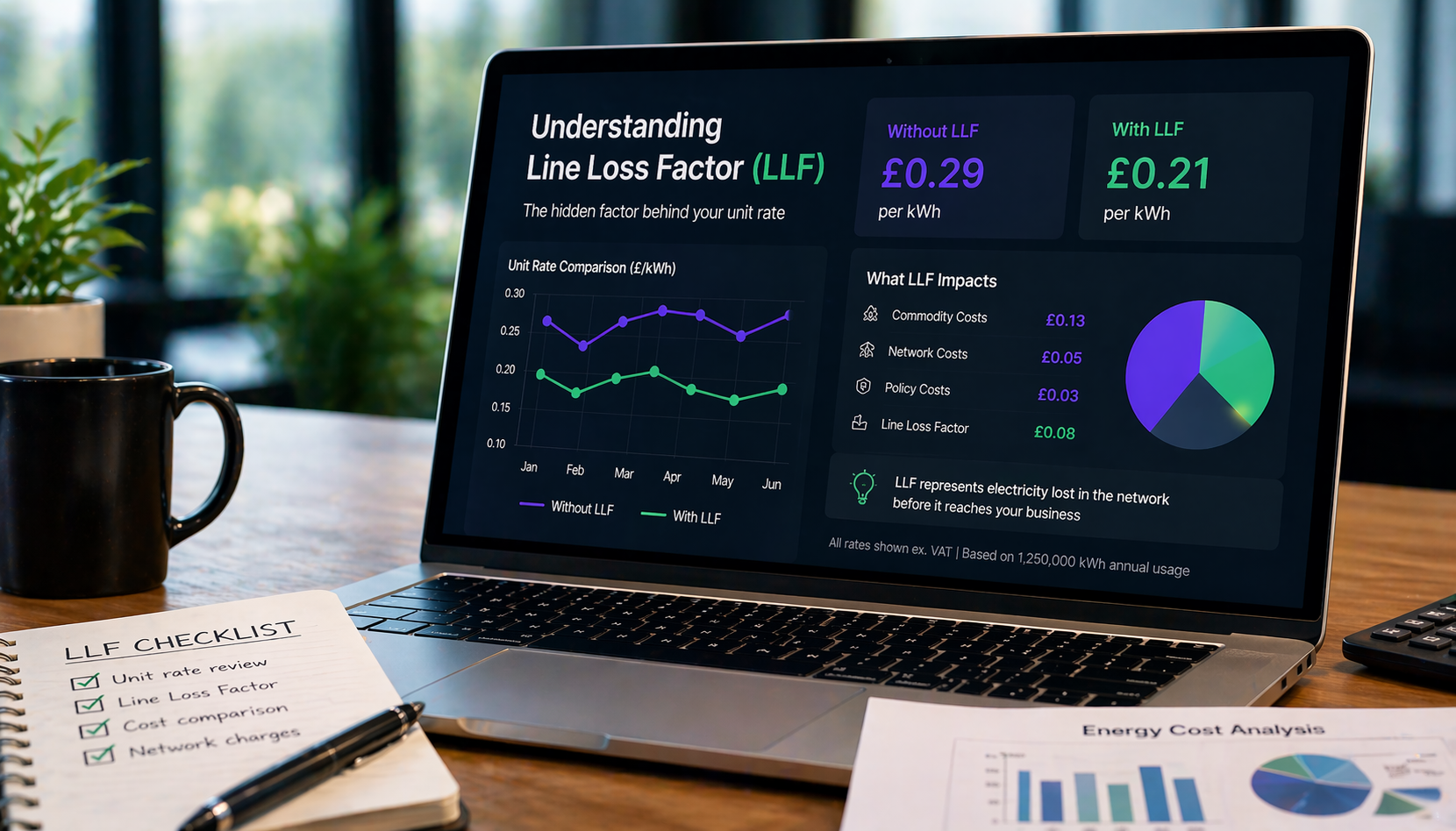
Most businesses keep a close eye on their energy usage. But we often find costs are still rising, even when usage hasn’t increased and in some cases has actually fallen.
It is not unusual to see two businesses using similar amounts of electricity, on similar contracts, yet paying different electricity unit rates. This is one of the reasons business electricity costs do not always behave as expected.
At first glance, both look like they are doing the right things.
- They have switched supplier.
- They have negotiated their rates.
- They review contracts when they come up for renewal.
But the outcome is still different.
What is Line Loss Factor (LLF)?
Part of the reason sits in something called a Line Loss Factor.
Electricity does not arrive at a site in the same state it leaves the grid. As it travels through cables and infrastructure, a small amount is lost along the way.
LLF reflects that loss.
Each business is assigned a factor based on how its site is connected to the network. This can vary depending on the local distribution network, voltage level and how the site is set up.
That factor is used to adjust the units used for billing, which in turn affects the effective price paid per unit.
So while two businesses may agree similar rates on paper, the actual price they pay per unit can still differ depending on how losses are applied to that site within the network.
Why electricity prices differ between businesses
This is not something most businesses notice immediately.
It tends to show up over time, usually when comparisons start to happen.
A business may begin to question why one site costs more to run than another, even though usage is similar. Or they may switch supplier expecting a clear reduction, only to find that costs improve less than anticipated.
Because LLF sits within the unit rate, it does not stand out on a bill. It is usually absorbed into the rate rather than reviewed as a separate factor.
That is why it often goes unnoticed, even in businesses that manage their energy closely.
If any of this sounds familiar, it is usually worth a quick sense-check.
Why LLF is often missed in energy contracts
Most energy reviews are built around price.
The focus is usually on negotiating unit rates, selecting suppliers and securing contract terms. Those are all important, but they only address part of the picture.
LLF sits outside of that process.
It is not something a supplier typically changes during a contract negotiation, and it is not always something that is reviewed unless there is a clear reason to look for it.
As a result, a business can be confident they have secured a good deal, while still carrying differences in cost that were never part of the conversation.
When It Becomes Worth a Closer Look
LLF does not need constant attention, but there are certain points where it becomes more relevant.
It is often worth checking when a business starts to compare sites more closely, or when expected savings do not fully materialise after a change in supplier.
It can also become more relevant as a business evolves. Sites that have been in place for years are often still set up in the same way they were originally, even if the business itself has changed.
At that point, the question is not whether something is wrong, but whether everything is still aligned.
A simple example
We recently reviewed a business operating across several locations.
On paper, everything looked consistent. The contracts were aligned, and nothing stood out as unusual.
However, one site was consistently showing a higher cost per unit than the others, despite similar usage.
When we looked beyond the contract and into how the site was set up within the network, we found that the difference related to how that site was categorised on the distribution network, which affected the line loss factor applied.
Once that was understood, the variation in cost was no longer a mystery.
It had simply never been looked at in that way before.
What a Review Actually Looks At
This is where most businesses find the gap.
A typical review focuses on price and contract terms. A more complete review looks at the setup behind those costs.
That includes how electricity is delivered, how it is recorded and whether the underlying setup reflects how the business actually operates today.
LLF is one part of that wider picture, alongside other factors such as agreed capacity (kVA) that can influence cost without being immediately visible.
How Switch365 Approaches This
At Switch365, we take a broader view of energy.
Through our Triage energy review, we look beyond unit rates to understand how each site is structured and whether anything sits outside of what would normally be reviewed.
This includes factors like LLF, alongside other areas where cost differences or inefficiencies can build over time.
For most businesses, it is not about making changes straight away. It is about gaining clarity on what is driving cost and whether anything has been missed.
A More Complete View of Energy Costs
Energy is often treated as a pricing exercise, but in reality, it is shaped by a combination of factors that sit behind the contract.
LLF is one of those factors.
It is not something businesses need to manage day to day, but understanding it helps explain why costs do not always behave as expected.
If costs are not behaving as expected, the cause is not always the supplier or the contract — it can sit in how the site is set up behind it. And in some cases, it highlights areas that are worth a closer look.
If you’d like us to sense-check your current setup, we can quickly confirm whether everything looks right or if anything is worth a closer look.
